





KPM Berlin 's long tradition has inspired many stories, and Tom Saller tells a very special one in his second novel, *Ein neues blue*. We spoke with him about how fiction and reality come together in his work—and also learned which piece from our manufactory is his favorite.

Interview with Tom Saller - author of 'A new blue'
INTERVIEW WITH TOM SALLER – AUTHOR OF "A NEW BLUE"

What inspired you to write your new book?
As is so often the case when writing a novel, it’s the detour that leads to the destination. Originally, I wanted to write a book about Elly Beinhorn, another strong female figure from the early 20th century. While researching aviation, I came across the “Hermes” service, which Marguerite Friedlaender had designed for the newly opened restaurant at the Leipzig- Halle Airport. I also saw pictures of her famous “aviator cup,” whose mirrored surface is cut out in the lower shell so that it remains stable during flight. I was fascinated by the simplicity of the designs and their innovative approach.
Which came first? The idea for the story or the setting surrounding the " KPM Berlin"?
Certainly the idea of the story, or rather, its main character, Lili Kuhn. I had her in mind from the beginning. A (half-)Jewish girl who grows up motherless and is raised by her father and two buddies, a Japanese man and a rabbi. I intended to follow Lili into old age, specifically into the 1980s, where she meets the other main character, Anja, 18 years young. The meeting of the two generations appealed to me.
Did you have any prior connection to KPM Berlin before you wrote your book?
Only indirectly; I knew that Lili would meet Marguerite Friedlaender in her youth. When I told a good friend, also a writer, that the topic of my new novel was porcelain, he said that he was well acquainted with the director of a Berlin hotel owned by Jörg Woltmann, the owner of KPM. If desired, he could try to establish contact.
" KPM Berlin " has a very long history. Why did you set your novel in the early 20th century, of all times?
This is partly due to my previous novel "Wenn Martha tanzt". It takes place to a large extent at the Bauhaus in Weimar, where I had already met Marguerite Friedlaender. During my research on KPM, I came across Günther von Pechmann, who had been appointed director of the manufactory at the end of the 1920s. Both personalities had set themselves the goal of using the spirit of optimism of the 1920s to modernize the rather traditional designs to which the porcelain had been subject up to that point. In addition, von Pechmann had in mind the democratization of porcelain in the sense of high-quality everyday tableware for everyone - exciting, I thought.
What particularly fascinated you while researching * KPM Berlin * and the contemporary history of that period?
In particular, the character of Günther von Pechmann, who managed to resist being co-opted by the Nazis until the late 1930s—even though the external pressure was intense and his wife, like Lili, was also half-Jewish. The Nazis would have loved to see “Gröfaz” in the same league as “ Friedrich , der Große,” but von Pechmann resisted, so the KPM remained “off the line” for a long time. Instead, starting in the late 1930s, the SS operated its own porcelain factory in Munich-Allach.
What have you personally learned or taken away from working on this novel?
What a fantastic and still a little mysterious material porcelain is. The fact that it has a complex history spanning thousands of years, far beyond Europe. And that for a writer on a metaphorical level, the analogy between porcelain production and becoming human is irresistible: An object is formed, takes shape. It is fired and thereby gains strength. It receives a glaze and is suddenly no longer gray and unsightly, but shines in the light of reality. And then the final walk through the fire – only what proves itself in the fire will last.
What fascinates you personally about the KPM Berlin?
That it is the oldest surviving artisanal workshop on Berlin soil. That many people are familiar with “ Friedrich ” the Great, but don’t realize he has such a wonderful connection to porcelain making. That, in my view, KPM has succeeded in making the leap into the 21st century without compromising its values. I’m particularly fascinated by the people who work there. Those I’ve had the pleasure of getting to know are all passionate about the manufactory.
Do you have a favorite collection or a favorite piece?
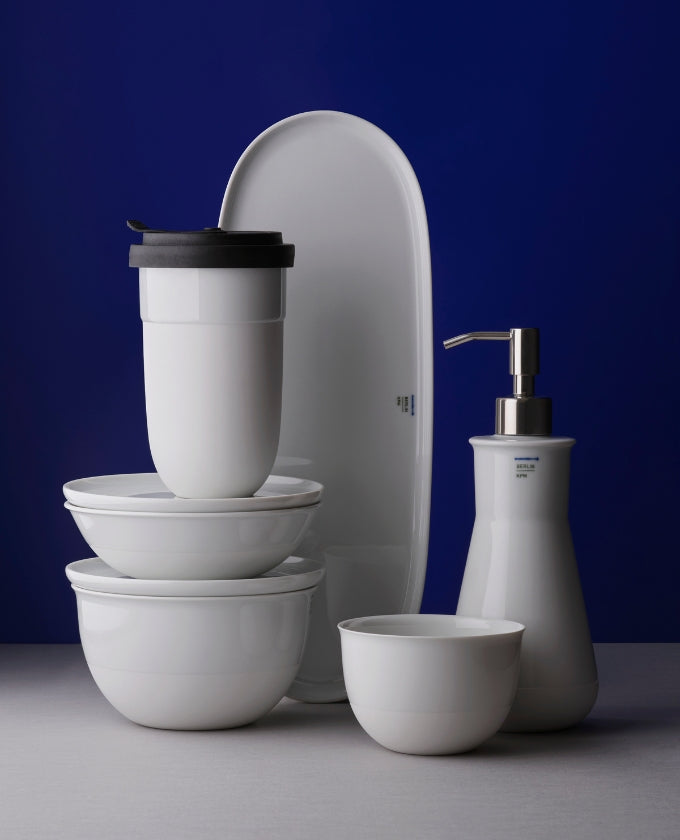
Marguerite Friedlaender's ”Halle Form” vases, Trude Petri's “Urbino” service and – newly – the products of the LAB series.
"Ein neues blue" by Tom Saller will be published by List Verlag on August 30, 2019.
A young woman is making her way as a porcelain painter at KPM...
When Lili's mother dies young, her father Jakob takes loving care of her. But it is only when she meets Günther von Pechmann, the director of the Royal Porcelain Manufactory, that she finds her destiny: the world of porcelain. But the National Socialists come to power and Lili has to flee Berlin.
Fifty years later, Lili lives again in Charlottenburg, withdrawn in her house with the Japanese garden. She doesn't talk much about herself and her eventful life. Only 18-year-old Anja, rebellious and contrary, can persuade Lili to open up to her. Little by little, Lili's story unfolds, but Anja also has a secret. What role does the simple porcelain bowl play, which the old woman guards like a treasure?
Share
Read more

Be our guest! - KPM Hotel & Residences in Berlin
BE OUR GUEST! A dream come true for porcelain lovers: At the " KPM Hotel & Residences " in Berlin, you can not only admire outstanding architecture and chic design, but...

All Eyes on: minimum
ALL EYES ON: MINIMUM Inspiration and good ideas often come out of the blue. That was certainly the case for Wilfried Lembert, founder and owner of the Berlin-based minimum stores: The idea for the collection...