






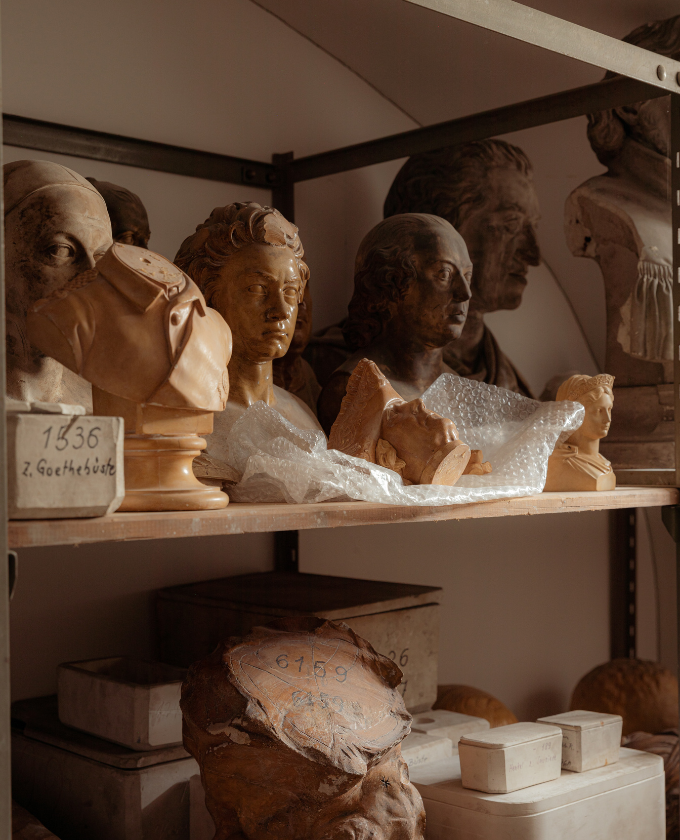
The KPM " ARKADIA " collection does more than just adorn your table. Thanks to the medallions by Siegmund Schütz, it also transports you to the fantastical world of ancient myths, sparking exciting conversations. Discover these little gems!

Siegmund Schütz and the delicate medallions of the KPM Collection ARKADIA
SIEGMUND SCHÜTZ AND THE DELICATE MEDALLIONS OF THE KPM COLLECTION ARKADIA
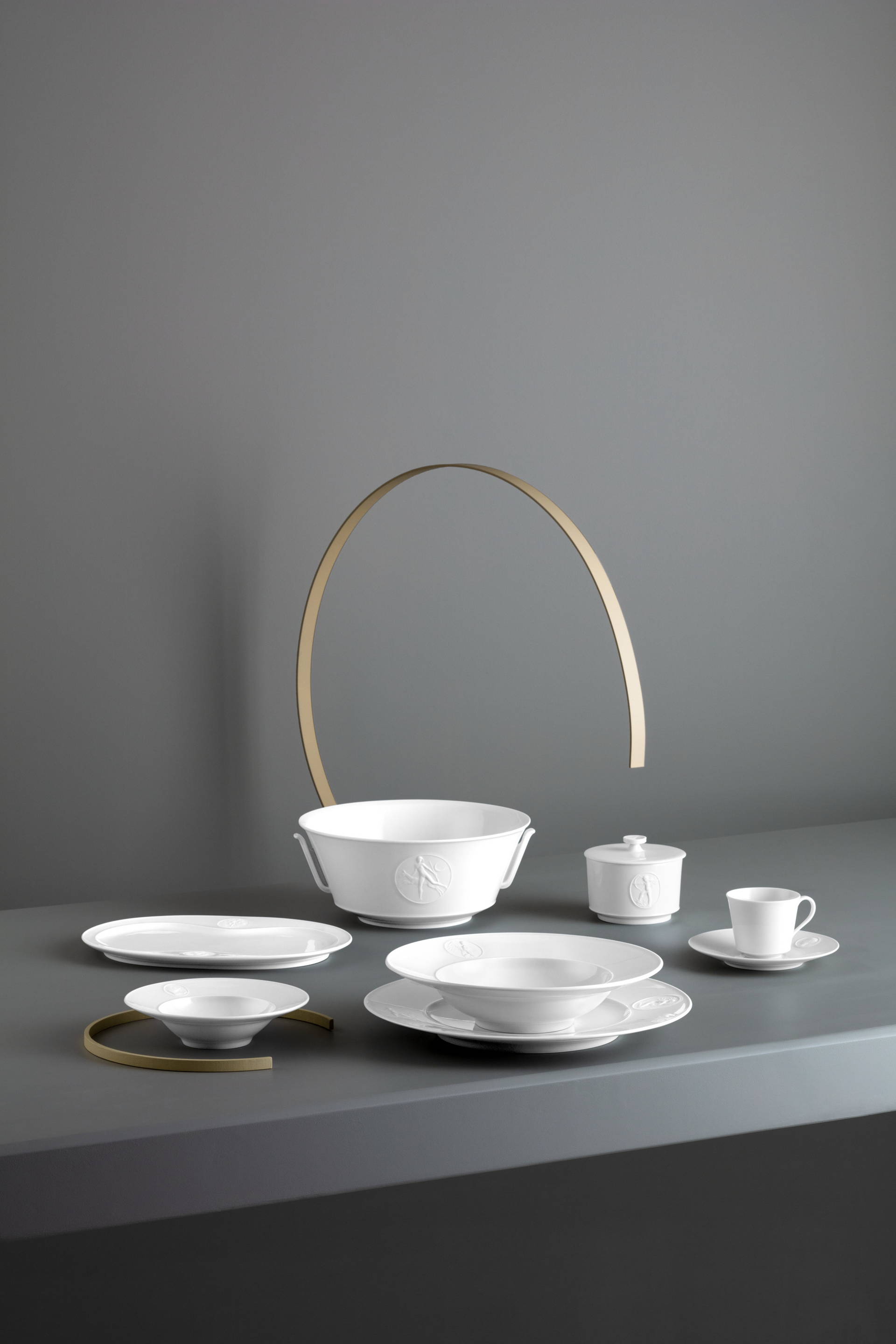
In the early 1930s, sculptor Siegmund Schütz created a series of delicate relief medallions for KPM Berlin, which were originally intended as standalone decorative cameos. Building on these medallions, Trude Petri designed a matching tea service in 1938—to mark KPM’s 175th anniversary—called the “ ARKADIA.”
Relief medallions made of unglazed porcelain, known as biscuit porcelain, were used on the sides of the glossy glazed vessels and plate flags. In the six place settings with different cookie medallions, the main motif of the plate is varied on the saucer. Thematically, the small medallions tie in with the ancient gem tradition. They tell stories from the dreamland of Arcadia, which the Roman poet Virgil made the setting for his works. To this day, they shape the idealized image of pastoral life in Arcadia and Greece. Let's take a closer look at the fragile relief medallions and their ancient motifs:
Ceres and the ears of wheat
The " ARKADIA " dessert plate, with a diameter of 210 mm, features Ceres—the daughter of Saturn and Ops—as one of six relief medallions. She is the Roman goddess of agriculture and fertility. Her Greek name is Demeter, daughter of Cronus, leader of the Titans, and Rhea, goddess of the cornfields. She is often depicted with fruit, a torch, a cornucopia, and ears of grain, and embodies summer. Before sowing and after the spring sowing was completed, women would offer her a public sacrifice. On the medallion, Ceres divides it into a sunny half and a rainy half, in which she holds a seedling in her hand.

ARKADIA Dessert plate
75,00€
The “ ARKADIA ” tea saucer, with a diameter of 170 mm, features ears of grain—the attribute of the mother goddess Demeter—as one of six relief medallions. As one of the twelve Olympian deities, she is responsible for the fertility of the earth, grain, and seeds. Her Roman name is Ceres. The ears of grain symbolize life and the abundance of possibilities yet to be realized. The oldest wheat finds date back to around 7800 B.C., making wheat the second-oldest grain after barley.

hunting Diana and the moon
The medallion on the “ ARKADIA ” salad bowl (200 mm in diameter), crafted from the finest bisque porcelain, depicts Diana, the Roman goddess of the hunt and the moon, and protector of women and girls. She corresponds to Artemis in Greek mythology. She is often depicted as a young huntress wearing a short chiton, carrying a quiver of arrows and a bow, and accompanied by a young stag or a dog.
Diana is the daughter of Zeus and Leto and is one of the twelve great Olympian gods, making her one of the most important deities in Greek mythology. Diana is depicted on the medallion hunting at night with a dog and a spear in her hand.

The oval creamer with a capacity of 0.12 liters of the Amor mocha service shows the moon goddess Selene and a crescent moon, a much-used symbol of ancient mythology, on its relief medallion. The personified moon in the form of Selene embodies the female principle and is equated with becoming and passing away on earth due to its changeable shape.
The moon is also one of the symbols of fertility. Together with her two siblings Eos, goddess of the dawn, and Helios, the sun god, she brings about the change from day to night on a daily basis. On the delicate medallion, Selene appears in profile with her hair loose in a crescent moon.

Animal companions
The “ ARKADIA ” tea saucer features two fish as the motif on its relief medallion. The fish are associated with Neptune, the god of water, and the element of water, and are considered symbols of life, but also of death. Hesiod recounts how Aphrodite, the goddess of love, was playing with her young son Eros on the banks of the Euphrates when the giant monster Typhon appeared to destroy them both. She was saved because the river nymph sent the desperate goddess two large, gentle fish with a string tied to their tails. In gratitude for their rescue, both fish were then transformed into a constellation in the sky.

Another relief medallion on the “ ARKADIA ” tea saucer depicts a dolphin, which in Greek mythology appears as the animal associated with the goddess Demeter as well as with the sea god Poseidon Hippios. The Greeks and Romans regarded it as godlike. When the sun god Apollo was born on an island in the middle of the sea, he was brought ashore by a dolphin. He, too, was elevated to the heavens as a constellation because he helped Poseidon win the hand of the sea nymph Amphitrite.

Cupid and putto awaken love
The round sugar bowl from the “ ARKADIA ” collection features, on its relief medallion crafted from delicate bisque porcelain, the god and personification of love: Cupid with his bow. The son of Venus and Mars is usually depicted as an adolescent boy who unerringly strikes hearts with his arrows, thereby awakening love.
No one can resist the power of Cupid, because: Omnia vincit Amor! ("Cupid conquers all!"). His Greek name is Eros. In art, we often encounter him in the form of so-called cupids, multiple depictions of child gods of love as naked, winged boys.
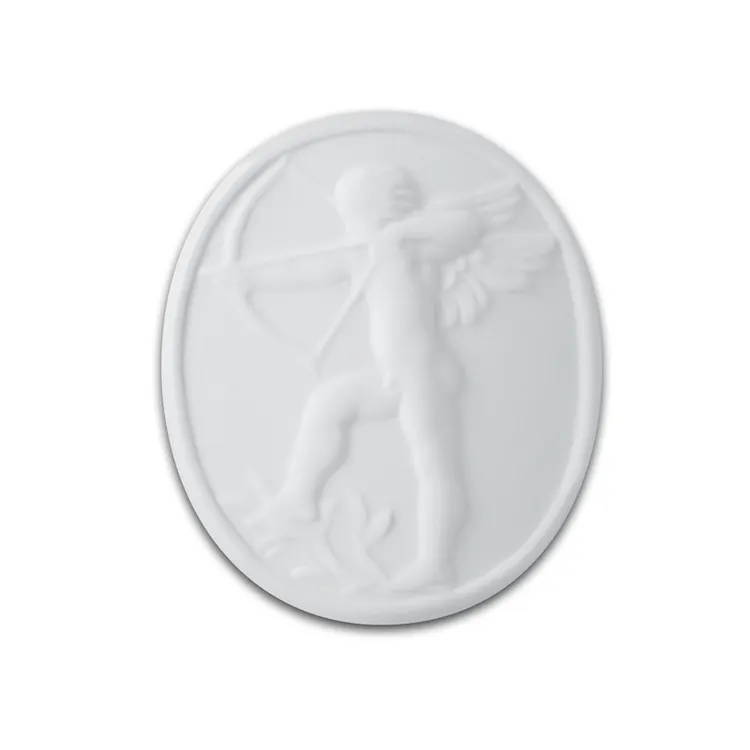
The elegant " ARKADIA " milk jug, with a capacity of 0.14 liters, features a putto treading grapes on its biscuit medallion. The figure of the boy is also a childlike depiction of Cupid, the Greco-Roman god of love, and is often portrayed as playful and carefree. In ancient mythology, wine symbolizes religious worship and culture.

The thyrsus rod
A teacup saucer from the “ ARKADIA ” collection features an ancient thyrsus—actually called a thyrsus or Bacchus staff—on its medallion. In Greco-Roman art, the thyrsus appears as an attribute of the Maenads, occasionally also of the satyrs and Sileni, of the god Dionysus himself, or of his wife Ariadne. Originally, the thyrsus is said to have been a staff made from a stalk of giant fennel, but later it was usually depicted as a branch or stick adorned with vines, grape leaves, and ivy.

Nereids, the nymphs of the sea
The elegantly designed " ARKADIA " gourmet plate is adorned with a medallion depicting a young Nereid, a nymph of the sea. These 50 daughters of the sea god Nereus and the Titaness Doris are the faithful companions of the god Poseidon. According to ancient mythology, they dwell in caves at the bottom of the sea, protect shipwrecked sailors and seafarers, and entertain them with games.
In many depictions, the Nereids are riding exuberantly on the backs of dolphins or hippocampi. The most famous Nereids are the beautifully curled and noble Calypso, who loves the shipwrecked Odysseus and therefore keeps him for seven years, and Galathea.

The beautiful Galatea is depicted on the relief medallion of the coffee pot from the “ ARKADIA ” collection. She is being carried across the water by her lover, the cyclops Polyphemus. This love story between the beautiful Nereid and Polyphemus—the terrifying figure of the wilderness who tries to civilize himself out of love for Galathea—serves as a primal inspiration for the well-known folk tale “Beauty and the Beast.”

A seashell is depicted as a delicate relief medallion on the “ ARKADIA ” tea saucer. As a creature that lives in the sea, it is often an attribute of sea deities and nymphs. Here, the seashell is associated with the Nereids as a symbol. In ancient times, people believed that the seashell was a genderless creature born from the sea foam, much like the Greek goddess of love and beauty, Aphrodite.

Aphrodite is often depicted standing on a shell as "the one rising from the sea". The Greek goddess of the sea, Doris, rides on a shell chariot, accompanied by her daughters, the Nereids, who swim around her.
Diomedes and Pegasus**, the legendary horses**
The relief medallion on the bread plate and coffee cup from the “ ARKADIA ” collection depicts the wild steed of Diomedes, one of the principal warriors of the Trojan War and king of Argos. His four wild mares became known in Greek mythology as the “Horse Beasts.” According to Greek mythology, Heracles’ eighth labor was to bring these horses to his cousin Eurystheus. According to Diodorus, he accomplished this feat by throwing Diomedes himself to the horses as food, thereby luring them toward the sea.

The generously sized ARKADIA serving plate, with a diameter of 32 cm, offers plenty of space for exquisite dishes. Its medallion, crafted from bisque porcelain, depicts Pegasus, the winged horse of Greek mythology and the child of the sea god Poseidon and the Gorgon Medusa. As a flying hybrid of horse and bird, it carried the hero Bellerophon in his battles against the Chimera and the Amazons. Zeus transformed Pegasus into a constellation. In a figurative sense, the winged Pegasus lives on today as a symbol of poetry.

Pan, his flute and the syrinx
The coffee saucer from the “ ARKADIA ” collection features Pan, the god of shepherds in Greek mythology, on its medallion. This hybrid creature, part human and part ram, was considered the god of the forest and nature. Pan is usually depicted holding a curved shepherd’s crook or a seven-tube flute—the pan flute. In ancient times, the curved shepherd’s crook symbolized the very nature of things and their cycle. According to mythology, Pan was the son of Hermes and Dryope, who was so startled by the sight of him that she fled from him.

The elegant dinner plate lends the table a stylish ambience and provides plenty to talk about: its relief medallion depicts Syrinx, a nymph from Greek mythology. In Ovid's Metamorphoses, she spurns the love of the shepherd god Pan. On her wild flight from him, she is transformed into reeds at the river Ladon in response to her pleas. As the desperate god's breath passes through the reeds, a poignant sound is produced, whereupon Pan cuts the reeds and makes a flute as a reminder of his love.

The " ARKADIA " tea saucer, with a diameter of 17 cm, also features a pan flute on its medallion. Pan invented this shepherd’s flute, which he named after the nymph Syrinx and on which he played his songs from then on. Pan also competed against Apollo in a musical contest with his pan flute: Pan boasted that he played more beautifully than the god of the arts. However, when Apollo—with his magnificent blond curls, purple robe, and laurel wreath—performed his audition on the kithara in an artistic pose, he won the contest.

Discover more pieces from the ARKADIA collection in our online store and explore the world of ancient mythology.
Share
Read more

What does it actually smell like at KPM Meistermalerei? | KPM Berlin
WHAT DOES IT ACTUALLY SMELL LIKE AT KPM MEISTERMALEREI? The short answer: Like an aromatherapy session. The fact that porcelain painting smells of lavender, anise, orange, and countless other...
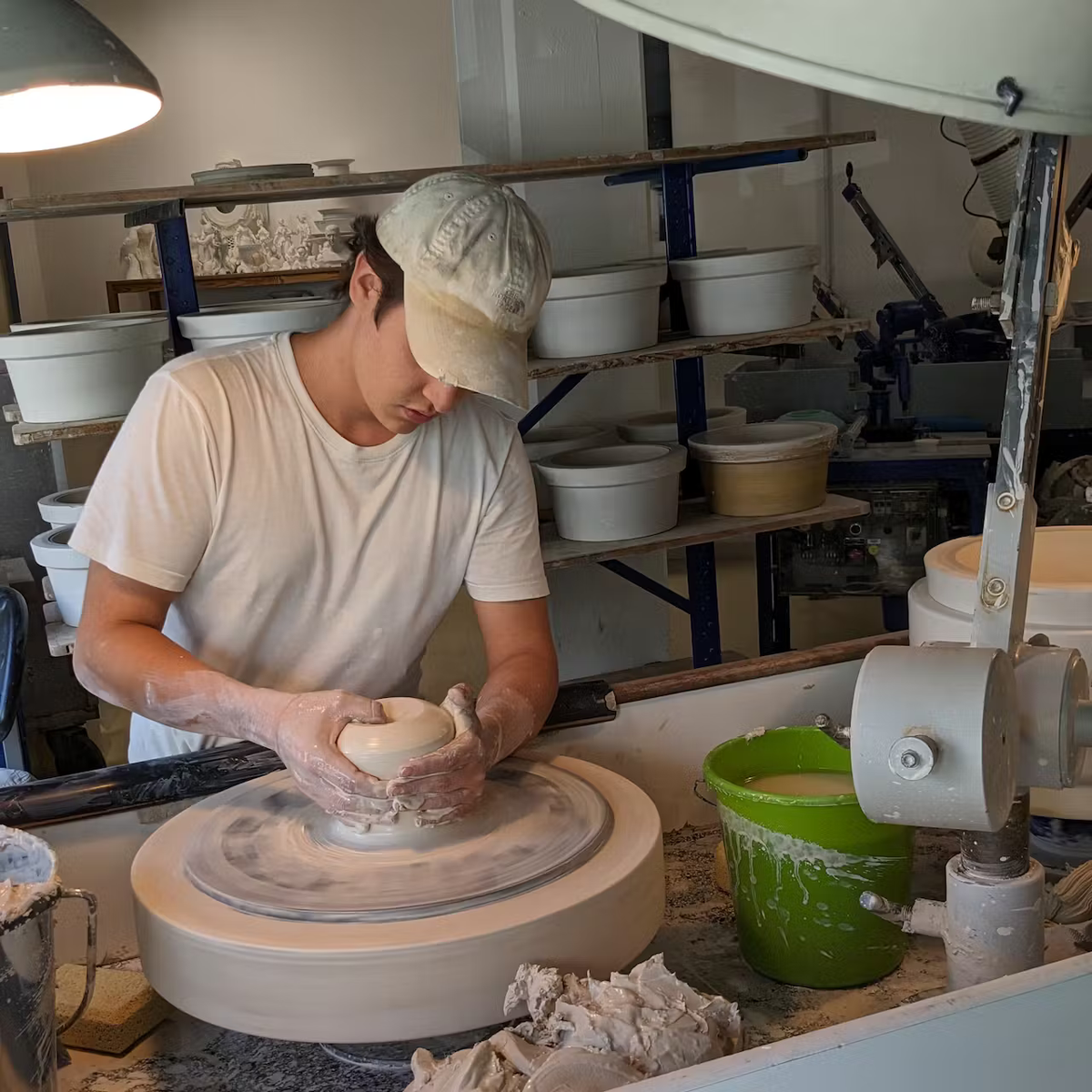
An internship day in the manufactory
A DAY OF INTERNSHIP AT THE MANUFAKTUR The “ KPM Berlin ” participated in Internship Week for the first time. Since 2020, the goal of Internship Week has been to provide practical insights for a well-informed career...